My presentation slides from the CPA PNG conference, as promised in my previous post, have now been loaded up here on my blog (they're available in PDF). Also the text of the speech is available here as a PDF as well (although it does lack my impromptu embellishments).
I very much enjoyed the opportunity to see an emerging profession in PNG, and it gives a bit of encouragement sitting back here in Brisbane where security guards are few and far between and it's reasonably likely that water and power supplies will be kept going indefinitely. The members of the profession there have a big challenge but with people like Chris, Lucy, Lia and Leeanne (? unfortunately they're the only names I recall, the Pondo Tavern was very dark and smoky and a few non-accounting sherbets may have been involved ?) the profession does have a bright beacon there.
And a big thank-you to CPA Australia & CPA PNG for the opportunity to present, and maybe one day I'll get the opportunity again.
Sunday, November 20, 2005


Friday, November 18, 2005
Welcome from Sunny PNG
It has been a long time between posts - this seems to be the downfall of most bloggers.
Some time ago I was asked by CPA Australia to present on the topic 'Management Information Reporting, including the IT Aspects' at the annual CPA Australia/CPA PNG joint conference in Port Moresby. I accepted despite the trepidation one gets when you know you'll have a 10-week-old baby, as well as a fractious two-year old, to look after (or rather, that you will have to leave with your loving wife when you go overseas!).
This blog post is coming from PNG (Crowne Plaza Hotel). I am here with Jim Dickson (International Director CPA Australia), Professor Colin Clarke (Vice President CPA Australia), and Patrick Hoiberg (former 'king poobah' of the ICAA),
The conference started yesterday with an opening by Jim Dickson and a keynote address by Colin Clarke, and then my presentation (after morning tea, of course).
The reaction seems to have been very positive (the audience was very kind, all 600 of them!), and I enjoyed giving the speech although we ran out of time for questions at the end (I had planned on an hour and a quarter but I had not reckoned on the logistics of the situation - getting 600 people to their seats is no easy task so every session tends to start late). If I can coax Jim Dickson to give me some photos, I will post them online here (tends to brighten up a blog!).
The IT Governance guide has rated a mention or two along the way, and everyone who has seen it has been very impressed. Jan Barned tells me sales have probably gone into the 200s already, which is very impressive for a newly launched guide. I understand I have a launch luncheon to attend on 1st December in Melbourne - so that should be good.
When I have access to my web storage (when I get back to Brisbane on Sunday) I will post the presentation slides and the text of my speech as near as I can get it, and we'll have that sorted then.
It's been very energising in PNG, and it seems to have been worth it.
Some time ago I was asked by CPA Australia to present on the topic 'Management Information Reporting, including the IT Aspects' at the annual CPA Australia/CPA PNG joint conference in Port Moresby. I accepted despite the trepidation one gets when you know you'll have a 10-week-old baby, as well as a fractious two-year old, to look after (or rather, that you will have to leave with your loving wife when you go overseas!).
This blog post is coming from PNG (Crowne Plaza Hotel). I am here with Jim Dickson (International Director CPA Australia), Professor Colin Clarke (Vice President CPA Australia), and Patrick Hoiberg (former 'king poobah' of the ICAA),
The conference started yesterday with an opening by Jim Dickson and a keynote address by Colin Clarke, and then my presentation (after morning tea, of course).
The reaction seems to have been very positive (the audience was very kind, all 600 of them!), and I enjoyed giving the speech although we ran out of time for questions at the end (I had planned on an hour and a quarter but I had not reckoned on the logistics of the situation - getting 600 people to their seats is no easy task so every session tends to start late). If I can coax Jim Dickson to give me some photos, I will post them online here (tends to brighten up a blog!).
The IT Governance guide has rated a mention or two along the way, and everyone who has seen it has been very impressed. Jan Barned tells me sales have probably gone into the 200s already, which is very impressive for a newly launched guide. I understand I have a launch luncheon to attend on 1st December in Melbourne - so that should be good.
When I have access to my web storage (when I get back to Brisbane on Sunday) I will post the presentation slides and the text of my speech as near as I can get it, and we'll have that sorted then.
It's been very energising in PNG, and it seems to have been worth it.
Tuesday, November 01, 2005
Emerging Issues in Information Systems Integration Risk
It is interesting to contemplate business risk and business benefit in today's commercial world. If we think about how the world has changed over the past thirty years (I am of course referring to information systems - and am completely ignoring other somewhat less momentous issues such as the end of the cold war, the rise of Islamic extremism, and the invention of Viagra), there originally were computer mainframes that the well-heeled business could put in place to process transactions. The diagram below gives a flavour of the history here:
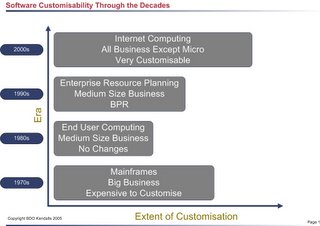
Mainframes were heavily customised - heck, at the beginning each one was a custom job. So they were heavily customised, had a long life to get anything like ROI out of them, and were expensive to maintain.
The rise of end-user computing - aka the rise of the PC - put computing in the hands of the masses, but those masses didn't have too many options to customise their computers given that most programs were off-the-shelf unless you were a dab hand at Pascal.
Client-server architectures, and the rise of enterprise computing, lead to fairly extensive customisation of systems, but in hindsight they were not nearly as complex as modern systems and were less integrated (it was still considered novel to integrate information from two databases into a data warehouse).
Todays' internet computing, though, is all about reliance upon the information systems and their inter-dependence. It is increasingly difficult to change one information system without affecting others - this is particularly the case for core information systems such as accounting information systems or human resource information systems.
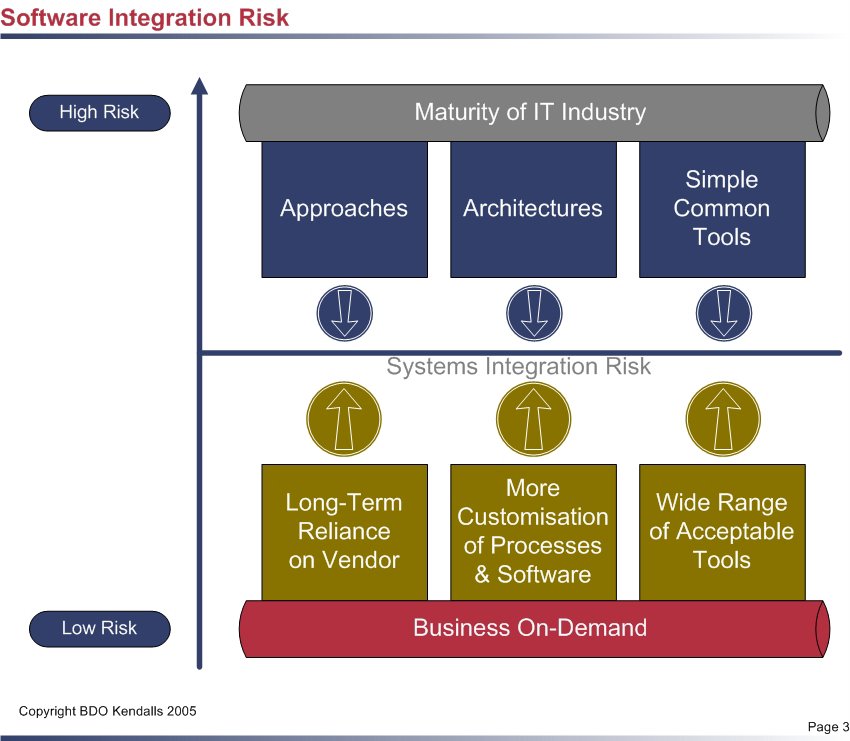
This has all occurred at a time when business, due to competitive pressures and the impact of globalisation, is increasingly turning to automation and information tools to 'produce the goods'. Increasing reliance on information systems, and increased customisation, results in increasing business risk:
 So despite the maturity of the information industry (e.g. with the development of common approaches, architectures, and ubiquitous development tools), the forces of evil are being brought to bear due to the requirement to have 'business on-demand' (a resurgent long-term reliance upon the vendor, increased customisation of business processes and software, and the use of a wide range of software development tools to undertake these tasks).
These factors are leading to increased systems integration risk, and the only solution that seems to exist at this time is to promote the use of methodologies, standard enterprise tools, and, as always, to document, document, document your customisations. And of course, as I often say to clients, have a Bex and a good lie down before seriously thinking about customising an off-the-shelf system. Having high information systems risks due to a customisation of a system to achieve business benefits is somewhat disconcerting; to have a high level of information system risks for customisations that did not achieve their supposed benefits is a more disturbing outcome.
(PS - BDO Kendalls is running an Emerging Issues in Risk Management Seminar on 8 November 2005 - see you there).
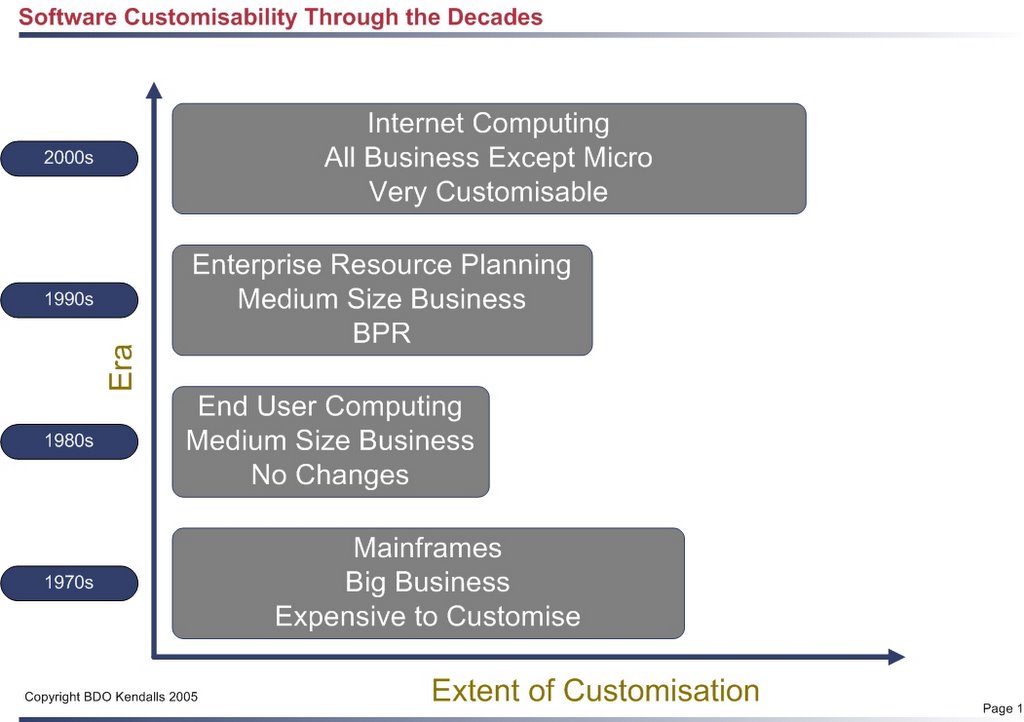
Mainframes were heavily customised - heck, at the beginning each one was a custom job. So they were heavily customised, had a long life to get anything like ROI out of them, and were expensive to maintain.
The rise of end-user computing - aka the rise of the PC - put computing in the hands of the masses, but those masses didn't have too many options to customise their computers given that most programs were off-the-shelf unless you were a dab hand at Pascal.
Client-server architectures, and the rise of enterprise computing, lead to fairly extensive customisation of systems, but in hindsight they were not nearly as complex as modern systems and were less integrated (it was still considered novel to integrate information from two databases into a data warehouse).
Todays' internet computing, though, is all about reliance upon the information systems and their inter-dependence. It is increasingly difficult to change one information system without affecting others - this is particularly the case for core information systems such as accounting information systems or human resource information systems.
This has all occurred at a time when business, due to competitive pressures and the impact of globalisation, is increasingly turning to automation and information tools to 'produce the goods'. Increasing reliance on information systems, and increased customisation, results in increasing business risk:
 So despite the maturity of the information industry (e.g. with the development of common approaches, architectures, and ubiquitous development tools), the forces of evil are being brought to bear due to the requirement to have 'business on-demand' (a resurgent long-term reliance upon the vendor, increased customisation of business processes and software, and the use of a wide range of software development tools to undertake these tasks).
These factors are leading to increased systems integration risk, and the only solution that seems to exist at this time is to promote the use of methodologies, standard enterprise tools, and, as always, to document, document, document your customisations. And of course, as I often say to clients, have a Bex and a good lie down before seriously thinking about customising an off-the-shelf system. Having high information systems risks due to a customisation of a system to achieve business benefits is somewhat disconcerting; to have a high level of information system risks for customisations that did not achieve their supposed benefits is a more disturbing outcome.
(PS - BDO Kendalls is running an Emerging Issues in Risk Management Seminar on 8 November 2005 - see you there).
Thursday, October 27, 2005
Out Now in Your Online Bookstore
CPA Australia has just released for purchase the IT & Management CoE's publication, IT Governance: A Practical Guide for Company Directors and Corporate Executives. The co-authors were Chris Gillies and Marianne Broadbent of Gartner. I was a member of the steering committee for this publication, and it is in the end a document that we are all proud of.
In particular, Jan Barned - an unheralded contributor but the policy advisor for the IT & M Centre of Excellence - did a good job of keeping us all on track and making sure that it hit the deadlines on time. A mammoth effort to get it there and some very good lessons learned by Jan and for CPA Australia.
The publication is an excellent result, and of course you can buy it here for $A55 (and I know how much effort and time went into it, and it's cheap at twice the price).
In particular, Jan Barned - an unheralded contributor but the policy advisor for the IT & M Centre of Excellence - did a good job of keeping us all on track and making sure that it hit the deadlines on time. A mammoth effort to get it there and some very good lessons learned by Jan and for CPA Australia.
The publication is an excellent result, and of course you can buy it here for $A55 (and I know how much effort and time went into it, and it's cheap at twice the price).
Wednesday, October 19, 2005
Chief Information Officers - The Glue That Binds
ZDNet have an article by Steve Ranger called 'CIOs must bridge gap between business and tech'. The essential point of the article is that the role of CIO is not technical, it is about business strategy and implementing that in the technical sphere.
The CIO is responsible for the stewardship of technological resources within a defined architectural framework - and then implementing strategic direction (not technical implementation!) to achieve technological goals.
This echoes the discussion CPA Australia was having recently regarding information technology governance. Keep it simple for the board, and break up the tasks in terms a layman can understand: Keeping It Running, Plan It, Manage It, and Build it. At the end of the day, that's all that's involved in IT (it's a lot more complex than that, technically, but business-wise - that's all that matters.
The CIO is responsible for the stewardship of technological resources within a defined architectural framework - and then implementing strategic direction (not technical implementation!) to achieve technological goals.
This echoes the discussion CPA Australia was having recently regarding information technology governance. Keep it simple for the board, and break up the tasks in terms a layman can understand: Keeping It Running, Plan It, Manage It, and Build it. At the end of the day, that's all that's involved in IT (it's a lot more complex than that, technically, but business-wise - that's all that matters.
Wednesday, October 12, 2005
Business Blogging InTheBlack
This week's CPA journal has an article in it - "It's time to Enter the Blogosphere" - in which your humble correspondent is quoted. The article came about partly because of a discussion our Centre of Excellence had regarding blogs and wikis and such like, and our biggest booster Jan Barned suggested the topic to the editor of InTheBlack. And then the genie is let out of the bottle!
The article is also reproduced at Ed Charles' own blog. Another "avid blogger" quoted in the article is Trevor Cook of the PR firm Jackson Wells Morris.
Good to see I'm not the only one out there blogging away to an unconfirmed audience. Corporate blogging on the rise. I am particularly interested in exploring the ideas of using the internal blog for more effective project coordination.
The article is also reproduced at Ed Charles' own blog. Another "avid blogger" quoted in the article is Trevor Cook of the PR firm Jackson Wells Morris.
Good to see I'm not the only one out there blogging away to an unconfirmed audience. Corporate blogging on the rise. I am particularly interested in exploring the ideas of using the internal blog for more effective project coordination.
Viva la ITIL Revolution!
Australia's CIO Magazine has recently (well, yesterday) published an article entitled "ITIL Power" by Ben Worthen. This article is a relatively practical and in-depth review of the capabilities of ITIL (Information Technology Infrastructure Library) and when (and when not) to use it.
It's worth comparing and contrasting this perspective with the view from Technology Executive Club in an article by Alcyone Consulting regarding the synergies between CObIT and ITIL.
As I say, ITIL and CObIT are good ways of making information technology "boring", which is a good thing for business!
It's worth comparing and contrasting this perspective with the view from Technology Executive Club in an article by Alcyone Consulting regarding the synergies between CObIT and ITIL.
As I say, ITIL and CObIT are good ways of making information technology "boring", which is a good thing for business!
Tuesday, October 11, 2005
All About Information Taxonomies - Yet Another Blog
Further to the Ark Group presentation on information taxonomies on Wednesday, Ark Group have put forward a moderated forum for the further discussion and comment on Information Taxonomies.
You can click here for further information.
The welcome message is reproduced below:
You can click here for further information.
The welcome message is reproduced below:
"Welcome to the Ark Group Taxonomy Forum. Following on from Designing a Business Focused Taxonomy, we felt that it would be useful to start a discussion forum. The way that the discussion and topics progress is entirely up to you - the members.
Ideally, all discussions should be targeted towards particular business issues that you face with your taxonomy project. Please feel free to introduce yourself and organisation and your particular area of interest."
Thursday, October 06, 2005
To make omelettes, you have to break eggs - but do it very, very carefully!
Last week I presented to Ark Group's Business Information Taxonomies Conference on the topic "Understanding the Purpose of Your Taxonomy and Ensuring Business Adoption" at the Avillion Hotel.
My uploaded presentation can be found here.
In case you are wondering, a (very loose) definition of information taxonomy is a way of classifying and categorising the creation of unstructured information in a way that lets you more easily identify what is contained in the document, and how it relates to areas of your organisation. Although this helps with the search process (you can determine at a glance what a document is about rather than full-text searching for it).
One of the interesting things I discovered at the conference was the presentation by Verity on their tools, one of which (Verity Profiler) claims to be able to automatically classify a document into a taxonomy with about 85% accuracy.
The underlying theme of my presentation, however, was that generally people in business are very good at presenting the benefits of an information taxonomy, but are rarely able to really articulate a low-risk methodological approach to actually implementing the information taxonomy (or business classification scheme) in a way that actually has people use it.
So the benefits are fairly clear, but our ability to state how it is to be done, and to convince business management that it will actually achieve real outcomes, is often less clear.
So as I say, to make omelettes, you have to break eggs - but do it very, very carefully in case you break the business too!
My uploaded presentation can be found here.
In case you are wondering, a (very loose) definition of information taxonomy is a way of classifying and categorising the creation of unstructured information in a way that lets you more easily identify what is contained in the document, and how it relates to areas of your organisation. Although this helps with the search process (you can determine at a glance what a document is about rather than full-text searching for it).
One of the interesting things I discovered at the conference was the presentation by Verity on their tools, one of which (Verity Profiler) claims to be able to automatically classify a document into a taxonomy with about 85% accuracy.
The underlying theme of my presentation, however, was that generally people in business are very good at presenting the benefits of an information taxonomy, but are rarely able to really articulate a low-risk methodological approach to actually implementing the information taxonomy (or business classification scheme) in a way that actually has people use it.
So the benefits are fairly clear, but our ability to state how it is to be done, and to convince business management that it will actually achieve real outcomes, is often less clear.
So as I say, to make omelettes, you have to break eggs - but do it very, very carefully in case you break the business too!
Tuesday, October 04, 2005
OpenDocument Standards
ZDNet is reporting on the new OpenDocument standard (approved by OASIS) that may "turn the world inside out" (which, frankly, is one of those phrases to use when hyperbole just isn't enough). It does promise great things, as the promise of sharing documents independently of the application that created them may finally become a reality (although, predictably, Microsoft advises it refuses to support an inferior standard and will accordingly go its own way).
I suspect we shouldn't hold our breath in this regard. However, if there is enough momentum to using it, the potential for open source software applications to really become usable (e.g. OpenOffice) would become very high. I personally use OpenOffice at home and for almost everything I do it is perfectly OK. I do remain sceptical of the great and wonderful features that are packed into Office most of the time - I mean, seriously, does anyone ever use the Version Save feature of Word? And if you do, do you hope and pray it won't corrupt your document?
(PS in case you are wondering what the reason is for the gap in publishing my blogs, the gap is due to the birth of my baby daughter, Olivia Grace on 9th September. Parenthood - it's good for family life, bad for blogging).
I suspect we shouldn't hold our breath in this regard. However, if there is enough momentum to using it, the potential for open source software applications to really become usable (e.g. OpenOffice) would become very high. I personally use OpenOffice at home and for almost everything I do it is perfectly OK. I do remain sceptical of the great and wonderful features that are packed into Office most of the time - I mean, seriously, does anyone ever use the Version Save feature of Word? And if you do, do you hope and pray it won't corrupt your document?
(PS in case you are wondering what the reason is for the gap in publishing my blogs, the gap is due to the birth of my baby daughter, Olivia Grace on 9th September. Parenthood - it's good for family life, bad for blogging).
Subscribe to:
Posts (Atom)