I have decided to get quite serious about this blogging caper and so have moved my blog to www.michealaxelsen.com.
This blog should now redirect, but if it does not, please go to that address.
Thanks: Micheal Axelsen
Friday, January 20, 2006


Thursday, January 19, 2006
Blogs, Wikis, and RSS
Apparently having been provided with a tag of "top blogger" and "blogging evangelist", I am down to speak to the topic of "Implementing Your Online Collaboration Strategy" for Key Forums on 29th March 2006 at Harbourview Hotel.
It promises to be an interesting conference, given the people speaking:
It promises to be an interesting conference, given the people speaking:
- Jackson Wells Morris
- Thinking Home Business
- The Podcast Network
- Education.au Ltd
- Fairfax Digital
- Deakin University
- Microsoft Australia
- BDO Kendalls
- Industry Capability Network
- Bibby Financial Services Australia
- Baker and McKenzie
- Yahoo!
- Acer Computer Australia
I am speaking on Implementation and Technology, particularly on that whole, rather largeish, 'people' side of the equation. Full details are available from Key Forums.
Wednesday, January 18, 2006
There has been a slight interruption to blogging services, normal service will return as soon as possible.
It would seem high time I made a blog entry again. It has been Christmas season as we all know and four weeks off with two small children has not been conducive to blogging - maybe my blogging gene has been defective.
More (serious) blog entries to come. Incidentally, if you're reading this blog and have some comments to make, take a risk, live a little dangerously, and leave a comment (that isn't spam!).
Incidentally, I note a theory that many people that blog are extroverted introverts - they've met people and decide they're not that bad, but all in all they would really rather send emails or blog and imagine that the recipients of their wit respond appropriately at their witticisms. Me? I'm probably somewhere in the middle - you decide.
And no, this is not a reality TV show, which surely must be the lowest form of wit.
More (serious) blog entries to come. Incidentally, if you're reading this blog and have some comments to make, take a risk, live a little dangerously, and leave a comment (that isn't spam!).
Incidentally, I note a theory that many people that blog are extroverted introverts - they've met people and decide they're not that bad, but all in all they would really rather send emails or blog and imagine that the recipients of their wit respond appropriately at their witticisms. Me? I'm probably somewhere in the middle - you decide.
And no, this is not a reality TV show, which surely must be the lowest form of wit.
Thursday, December 15, 2005
Showdown: Wikipedia vs Britannica
I've said it before and I'll say it again: Knowledge is of two kinds, you either know it or you can find it on Wikipedia. This article discusses a study by Nature that took scientific, complex articles from both Britannica and Wikipedia and had them reviewed by experts. The result? Wikipedia and Britannica are reasonably close - the surprising thing is, they both had four "major" errors in 42 articles. Not a good hit rate for Britannica!
This is of course in sharp contrast with the recent kerfuffle over Wikipedia's accuracy and peer review process.
This is of course in sharp contrast with the recent kerfuffle over Wikipedia's accuracy and peer review process.
Wednesday, December 14, 2005
Australian Accounting Review Supplement
The Australian Accounting Review (Supplement #37, November 2005) issue devoted to information technology/systems issues was released in November. I reproduce a small portion of the supplementary edition editorial (which was co-written by John Campbell, Shauna Kelly, and myself - but mostly John) below:
Feature articles from the November 2005 edition of Australian Accounting Review (Supplement #37 only) include:
The traditional objective of accounting is to provide information about the pecuniary affairs of an organisation. While this is largely a historical activity that focuses on past performance, the information that accounting provides also forms a useful basis for future action. In this historical context, information technology is commonly viewed as providing a productivity-enhancing and cost-effective means of storing and monitoring transactions, standardising fundamental accounting operations and facilitating compliance and financial reporting obligations. Information technology has reduced the cost of these traditional accounting functions by facilitating the processing and monitoring of large amounts of information about organisational performance. Despite the accretion of these and other benefits to the profession in general, there still exists a degree of uncertainty about the role of accounting professionals in the selection, use and management of information technology in organisations.You can access this online through CPA Australia, or sometimes authors will provide copies upon request.The papers in this special Australian Accounting Review supplement address important aspects of information technology that are of relevance to accounting practitioners and researchers. The supplement has been commissioned by CPA Australia's Centre of Excellence for Information Technology and Management.*
The call for papers for this special edition attracted a large number of high-quality submissions, making the final selection process difficult. All research papers were peer-reviewed and carefully scrutinised by the Centre of Excellence to ensure that those selected for publication reflect the diversity of information technology issues relevant to the profession. The papers that follow deal with a broad range of topics, from discussion and research on IT governance, the impact of IT on business models, electronic business evaluation and adoption, information systems audit and control, IT investment decision-making and strategic planning in government agencies.
Feature articles from the November 2005 edition of Australian Accounting Review (Supplement #37 only) include:
Editorial: information technology - impacts and implications for accountingFeel free to email me if you you need details - these articles can usually be purchased through CPA Australia if you are not a subscriber.
Editorial for edition 37 of the Australian Accounting Review information technology supplement.
IT governance - are boards and business executives interested onlookers or committed participants?
This paper looks at what has to be governed and what IT governance needs to encompass to be effective, examines some of the issues of current IT governance practices from boardroom and business perspectives.
IT investment practices in large Australian firms
This review explores the procedures used by large Australian firms during the four major decisionmaking stages of the IT investment cycle: planning, evaluation, implementation and postimplementation review.
The social dimension of business and IS/IT alignment: case studies of six public-sector organisations
This paper presents the results of a study of the social dimension of the alignment of business strategy with information systems and information technology.
The pervasiveness of information and communication technology: its effects on business models and implications for the accounting profession
This paper discusses the main challenge that confronts firms because of the continued development in information and communication technologies (ICT) is the reduction in information asymmetry as product markets become increasingly information driven.
Consideration of options from an entrepreneuria, technical and operational perspective - an e-business design framework approach
This paper draws upon the emergent knowledge of e-business, together with traditional strategy theory, and provide a simple framework for the evaluation of business models for e-business.
The effect of e-commerce adoption on small/medium enterprise industry structure, competitive advantage and long-term profitability
This paper seeks to evaluate the relationship between e-commerce adoption and long-term profitability in small/medium enterprises (SMEs).
Information systems audit and control issues for enterprise management systems: qualitative evidence
This paper presents the results of a study on how the introduction of such software creates a new set of information systems audit and control problems.
Supplement on information technology
This issue of Australian Accounting Review is accompanied by a special supplement dedicated to new research work on Information Technology and Management.
Enterprise resource planning systems - implications for managers and management
This paper analyses the implications of enterprise resource planning systems for organisations in general and for managers and professionals in particular.
Monday, December 12, 2005
CPA PNG Photos
I did promise to post some photos from CPA PNG. The below photos, hopefully, communicate some of the breadth of the conference.
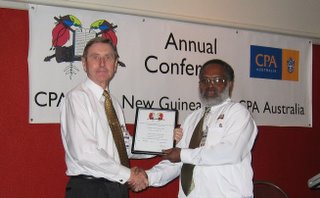
This photo shows Jim Dickson with Peter Pokawin - Jim is being awarded his fellowship of CPA PNG. Jim is CPA Australia's International Director, and this was his fifth (?) trip to the conference - although it has been a while due to a small bout of Ross River fever.
Peter is the President of CPA PNG, and all of us on that trip should thank Peter and CPA PNG for their never-ending hospitality and ability to make us - the interlopers from Australia - feel welcome.
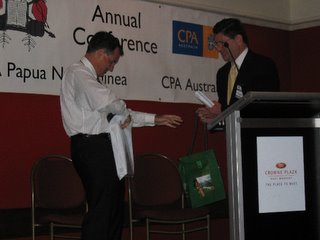
James Kruse, a partner from Deloitte PNG, is presenting Colin Clarke (Executive Dean of the Faculty of Business and Law at Victoria University) with his gifts as a presenter to the conference in the photo below, although knowing James one is uncertain as to exactly what he's going to find in that bag...
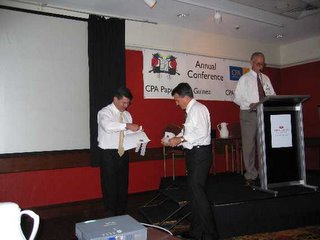
And Colin, James, and Bob Wheeler (Executive Officer of CPA PNG) in post-speech euphoria:
 More photos will be posted as events warrant.
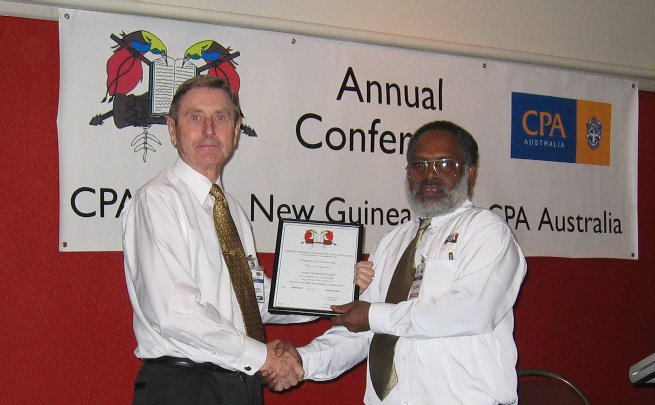
This photo shows Jim Dickson with Peter Pokawin - Jim is being awarded his fellowship of CPA PNG. Jim is CPA Australia's International Director, and this was his fifth (?) trip to the conference - although it has been a while due to a small bout of Ross River fever.
Peter is the President of CPA PNG, and all of us on that trip should thank Peter and CPA PNG for their never-ending hospitality and ability to make us - the interlopers from Australia - feel welcome.
James Kruse, a partner from Deloitte PNG, is presenting Colin Clarke (Executive Dean of the Faculty of Business and Law at Victoria University) with his gifts as a presenter to the conference in the photo below, although knowing James one is uncertain as to exactly what he's going to find in that bag...
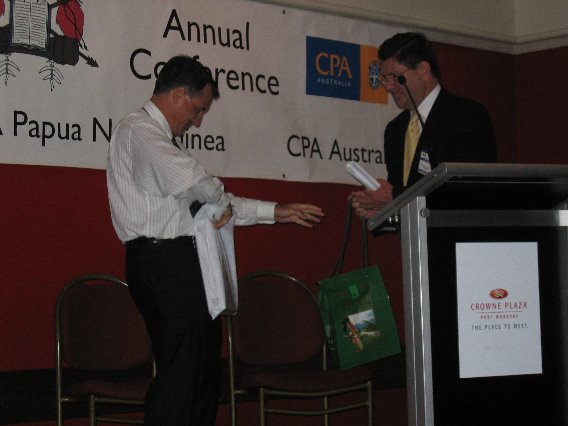
And Colin, James, and Bob Wheeler (Executive Officer of CPA PNG) in post-speech euphoria:
 More photos will be posted as events warrant.
SQL, SQL, SQL, SQL all the way...
Microsoft launched SQL Server 2005 on November 7 2005, and a month later it is a good time to see what people are saying about the new member of Microsoft's flock.
Microsoft clearly likes it - no surprises there. OS News noted the event in passing but did point out that Visual Studio 2005 is a strong companion product. SQLServerCentral.com has an article recording its correspondent's first impressions of SQL Server 2005. SearchWin2000 advises people to upgrade - eventually.
InfoWorld notes that there are marked improvements in programmability and manageability, whilst ZDNet notes that Microsoft is likely to speed up its server upgrade cycle somewhat.
That's a small wrap-up, anyway, so it is interesting to see where this newest release of SQL Server will take us. I haven't received my copy yet, so I cannot make any real comments yet. As usual, though, I am sure it will be a product that is easy to use and has some new features, probably somewhat incompatible with the previous versions. We will see what the Microsoft shepherd has brought to this area of activity.
Microsoft clearly likes it - no surprises there. OS News noted the event in passing but did point out that Visual Studio 2005 is a strong companion product. SQLServerCentral.com has an article recording its correspondent's first impressions of SQL Server 2005. SearchWin2000 advises people to upgrade - eventually.
InfoWorld notes that there are marked improvements in programmability and manageability, whilst ZDNet notes that Microsoft is likely to speed up its server upgrade cycle somewhat.
That's a small wrap-up, anyway, so it is interesting to see where this newest release of SQL Server will take us. I haven't received my copy yet, so I cannot make any real comments yet. As usual, though, I am sure it will be a product that is easy to use and has some new features, probably somewhat incompatible with the previous versions. We will see what the Microsoft shepherd has brought to this area of activity.
Thursday, December 08, 2005
Wham, Bam, Thank you Business Process Monitor
I note that CIO magazine's November 2005 edition has an article on business activity monitoring (BAM) which allows the business to respond to the changing environment, and be more responsive to problems in production. Although it can be simply about monitoring stock levels and sending a simple alert, it can be a whole lot more than that, and a lot more closely aligned with data mining and data warehouse techniques.
To find out more, read the article.
To find out more, read the article.
Friday, November 25, 2005
Take a developing nation, add a $US100 laptop, and stir
Open source software continues to have an impact that its founders may never have envisaged, although I'm certain they would approve. The United Nations has supported an initiative of a $US100 laptop - being pursued by the One Laptop Per Child non-profit organisation.
It's a hand-cranked (!) laptop capable of addressing most student's requirements. It includes a web browser, a word processor, email, and so on, and it's all based on Linux.
It was launched with a prototype on November 16th at the WSIS Summit in Tunis. I note that Andy Carvin has an 8-minute video covering the launch on his vlog at http://www.andycarvin.com/archives/2005/11/the_100_laptop.html.
Hmm. As always, everything I ever learn I learn from Wikipedia and Rocketboom.
It sounds like something that could indeed make the world a better place. Just imagine if developing companies really could have reliable ICT access and a generation that grows up using information systems and getting somewhere? Although $US100 is still a lot of money in some developing nations, it has to be better than the $US1,000 or so you'd need to pay out for the more standard system.
Given that it's Linux, they've got a lot of learning that they'll end up doing...
It's a hand-cranked (!) laptop capable of addressing most student's requirements. It includes a web browser, a word processor, email, and so on, and it's all based on Linux.
It was launched with a prototype on November 16th at the WSIS Summit in Tunis. I note that Andy Carvin has an 8-minute video covering the launch on his vlog at http://www.andycarvin.com/archives/2005/11/the_100_laptop.html.
Hmm. As always, everything I ever learn I learn from Wikipedia and Rocketboom.
It sounds like something that could indeed make the world a better place. Just imagine if developing companies really could have reliable ICT access and a generation that grows up using information systems and getting somewhere? Although $US100 is still a lot of money in some developing nations, it has to be better than the $US1,000 or so you'd need to pay out for the more standard system.
Given that it's Linux, they've got a lot of learning that they'll end up doing...
Thursday, November 24, 2005
Vlogging, Really Simple Syndication, and Finding Out Stuff
A couple of weeks ago, Rocketboom (an online video show) produced a show designed to demystify the idea of RSS (Really Simple Syndication). It's how you track blogs and alert readers of your blog when a new post has been entered ('zackly like this one).
So for that online, 3-minute video introduction of Really Simple Syndication, take it away Rocketboom does RSS.
Personally, I find bloglines the most useful since you can get it over the internet (even, apparently, in Port Moresby).
So for that online, 3-minute video introduction of Really Simple Syndication, take it away Rocketboom does RSS.
Personally, I find bloglines the most useful since you can get it over the internet (even, apparently, in Port Moresby).
Sunday, November 20, 2005
Blogs, Vlogs, & Wikis
During the presentation in PNG - a nation not blessed with the infrastructure for vlogs, but it should be - vlogs, blogs and wikis were discussed.
A future post is required on these, but two vlogs I sometimes watch are (note - since these vlogs are not mine, and they capture a bit of life as it is rather than airbrushed away, there can be 'rude bits' from time to time - just so you know, I am not responsible for the content!):
Karma Girl
Rocketboom
They're not usually too rude but that probably depends on your perception of rude.
A future post is required on these, but two vlogs I sometimes watch are (note - since these vlogs are not mine, and they capture a bit of life as it is rather than airbrushed away, there can be 'rude bits' from time to time - just so you know, I am not responsible for the content!):
Karma Girl
Rocketboom
They're not usually too rude but that probably depends on your perception of rude.
Presentation for CPA PNG
My presentation slides from the CPA PNG conference, as promised in my previous post, have now been loaded up here on my blog (they're available in PDF). Also the text of the speech is available here as a PDF as well (although it does lack my impromptu embellishments).
I very much enjoyed the opportunity to see an emerging profession in PNG, and it gives a bit of encouragement sitting back here in Brisbane where security guards are few and far between and it's reasonably likely that water and power supplies will be kept going indefinitely. The members of the profession there have a big challenge but with people like Chris, Lucy, Lia and Leeanne (? unfortunately they're the only names I recall, the Pondo Tavern was very dark and smoky and a few non-accounting sherbets may have been involved ?) the profession does have a bright beacon there.
And a big thank-you to CPA Australia & CPA PNG for the opportunity to present, and maybe one day I'll get the opportunity again.
I very much enjoyed the opportunity to see an emerging profession in PNG, and it gives a bit of encouragement sitting back here in Brisbane where security guards are few and far between and it's reasonably likely that water and power supplies will be kept going indefinitely. The members of the profession there have a big challenge but with people like Chris, Lucy, Lia and Leeanne (? unfortunately they're the only names I recall, the Pondo Tavern was very dark and smoky and a few non-accounting sherbets may have been involved ?) the profession does have a bright beacon there.
And a big thank-you to CPA Australia & CPA PNG for the opportunity to present, and maybe one day I'll get the opportunity again.
Friday, November 18, 2005
Welcome from Sunny PNG
It has been a long time between posts - this seems to be the downfall of most bloggers.
Some time ago I was asked by CPA Australia to present on the topic 'Management Information Reporting, including the IT Aspects' at the annual CPA Australia/CPA PNG joint conference in Port Moresby. I accepted despite the trepidation one gets when you know you'll have a 10-week-old baby, as well as a fractious two-year old, to look after (or rather, that you will have to leave with your loving wife when you go overseas!).
This blog post is coming from PNG (Crowne Plaza Hotel). I am here with Jim Dickson (International Director CPA Australia), Professor Colin Clarke (Vice President CPA Australia), and Patrick Hoiberg (former 'king poobah' of the ICAA),
The conference started yesterday with an opening by Jim Dickson and a keynote address by Colin Clarke, and then my presentation (after morning tea, of course).
The reaction seems to have been very positive (the audience was very kind, all 600 of them!), and I enjoyed giving the speech although we ran out of time for questions at the end (I had planned on an hour and a quarter but I had not reckoned on the logistics of the situation - getting 600 people to their seats is no easy task so every session tends to start late). If I can coax Jim Dickson to give me some photos, I will post them online here (tends to brighten up a blog!).
The IT Governance guide has rated a mention or two along the way, and everyone who has seen it has been very impressed. Jan Barned tells me sales have probably gone into the 200s already, which is very impressive for a newly launched guide. I understand I have a launch luncheon to attend on 1st December in Melbourne - so that should be good.
When I have access to my web storage (when I get back to Brisbane on Sunday) I will post the presentation slides and the text of my speech as near as I can get it, and we'll have that sorted then.
It's been very energising in PNG, and it seems to have been worth it.
Some time ago I was asked by CPA Australia to present on the topic 'Management Information Reporting, including the IT Aspects' at the annual CPA Australia/CPA PNG joint conference in Port Moresby. I accepted despite the trepidation one gets when you know you'll have a 10-week-old baby, as well as a fractious two-year old, to look after (or rather, that you will have to leave with your loving wife when you go overseas!).
This blog post is coming from PNG (Crowne Plaza Hotel). I am here with Jim Dickson (International Director CPA Australia), Professor Colin Clarke (Vice President CPA Australia), and Patrick Hoiberg (former 'king poobah' of the ICAA),
The conference started yesterday with an opening by Jim Dickson and a keynote address by Colin Clarke, and then my presentation (after morning tea, of course).
The reaction seems to have been very positive (the audience was very kind, all 600 of them!), and I enjoyed giving the speech although we ran out of time for questions at the end (I had planned on an hour and a quarter but I had not reckoned on the logistics of the situation - getting 600 people to their seats is no easy task so every session tends to start late). If I can coax Jim Dickson to give me some photos, I will post them online here (tends to brighten up a blog!).
The IT Governance guide has rated a mention or two along the way, and everyone who has seen it has been very impressed. Jan Barned tells me sales have probably gone into the 200s already, which is very impressive for a newly launched guide. I understand I have a launch luncheon to attend on 1st December in Melbourne - so that should be good.
When I have access to my web storage (when I get back to Brisbane on Sunday) I will post the presentation slides and the text of my speech as near as I can get it, and we'll have that sorted then.
It's been very energising in PNG, and it seems to have been worth it.
Tuesday, November 01, 2005
Emerging Issues in Information Systems Integration Risk
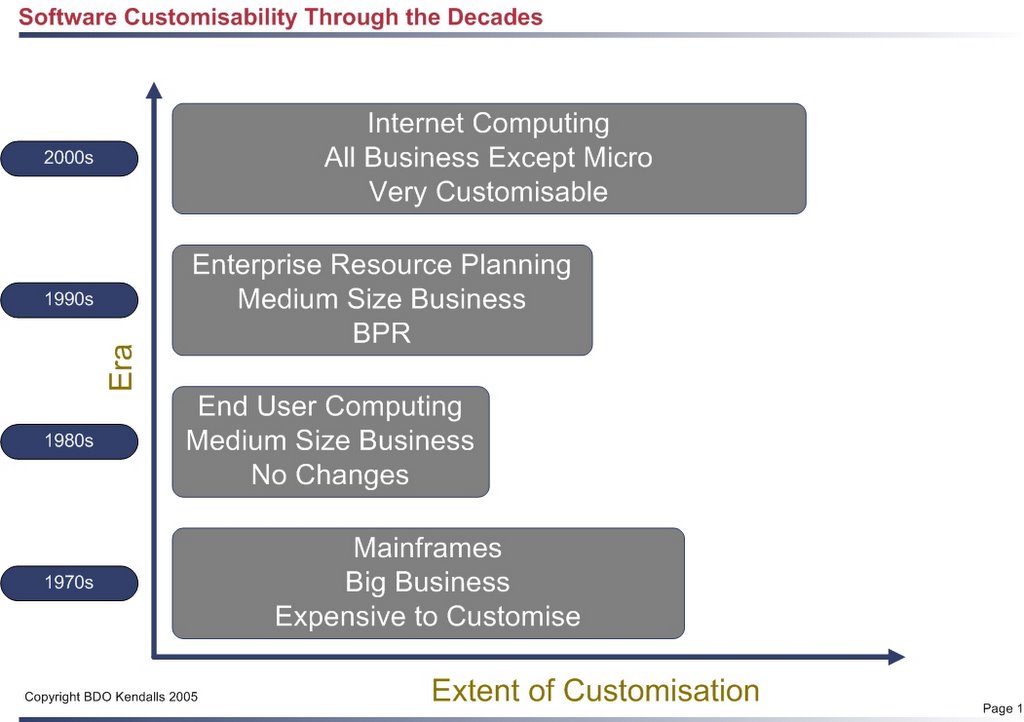
It is interesting to contemplate business risk and business benefit in today's commercial world. If we think about how the world has changed over the past thirty years (I am of course referring to information systems - and am completely ignoring other somewhat less momentous issues such as the end of the cold war, the rise of Islamic extremism, and the invention of Viagra), there originally were computer mainframes that the well-heeled business could put in place to process transactions. The diagram below gives a flavour of the history here:
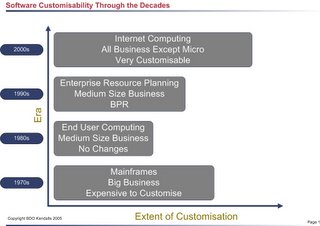
Mainframes were heavily customised - heck, at the beginning each one was a custom job. So they were heavily customised, had a long life to get anything like ROI out of them, and were expensive to maintain.
The rise of end-user computing - aka the rise of the PC - put computing in the hands of the masses, but those masses didn't have too many options to customise their computers given that most programs were off-the-shelf unless you were a dab hand at Pascal.
Client-server architectures, and the rise of enterprise computing, lead to fairly extensive customisation of systems, but in hindsight they were not nearly as complex as modern systems and were less integrated (it was still considered novel to integrate information from two databases into a data warehouse).
Todays' internet computing, though, is all about reliance upon the information systems and their inter-dependence. It is increasingly difficult to change one information system without affecting others - this is particularly the case for core information systems such as accounting information systems or human resource information systems.
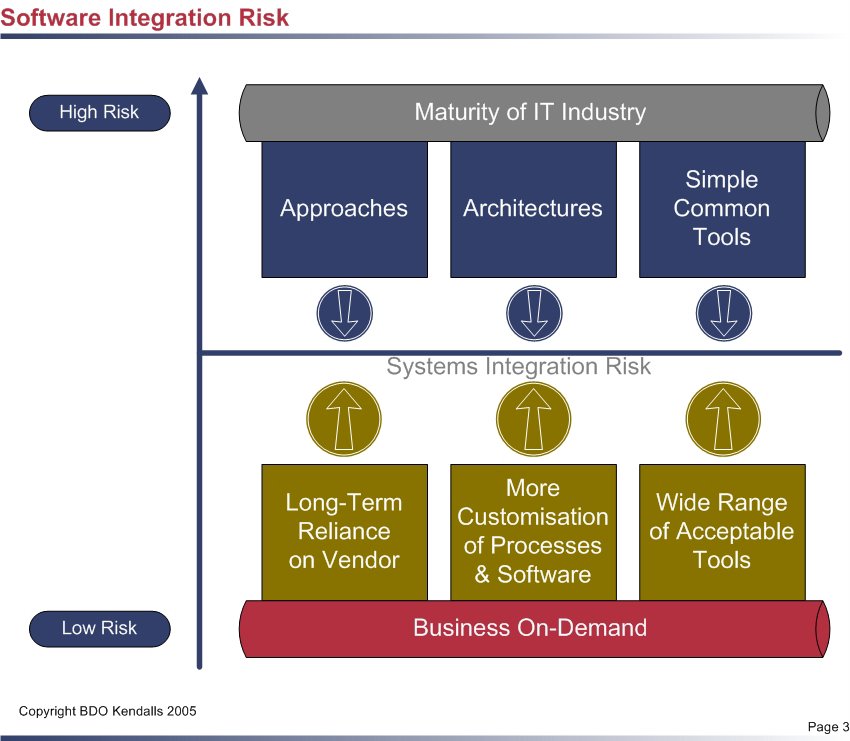
This has all occurred at a time when business, due to competitive pressures and the impact of globalisation, is increasingly turning to automation and information tools to 'produce the goods'. Increasing reliance on information systems, and increased customisation, results in increasing business risk:
 So despite the maturity of the information industry (e.g. with the development of common approaches, architectures, and ubiquitous development tools), the forces of evil are being brought to bear due to the requirement to have 'business on-demand' (a resurgent long-term reliance upon the vendor, increased customisation of business processes and software, and the use of a wide range of software development tools to undertake these tasks).
These factors are leading to increased systems integration risk, and the only solution that seems to exist at this time is to promote the use of methodologies, standard enterprise tools, and, as always, to document, document, document your customisations. And of course, as I often say to clients, have a Bex and a good lie down before seriously thinking about customising an off-the-shelf system. Having high information systems risks due to a customisation of a system to achieve business benefits is somewhat disconcerting; to have a high level of information system risks for customisations that did not achieve their supposed benefits is a more disturbing outcome.
(PS - BDO Kendalls is running an Emerging Issues in Risk Management Seminar on 8 November 2005 - see you there).
Mainframes were heavily customised - heck, at the beginning each one was a custom job. So they were heavily customised, had a long life to get anything like ROI out of them, and were expensive to maintain.
The rise of end-user computing - aka the rise of the PC - put computing in the hands of the masses, but those masses didn't have too many options to customise their computers given that most programs were off-the-shelf unless you were a dab hand at Pascal.
Client-server architectures, and the rise of enterprise computing, lead to fairly extensive customisation of systems, but in hindsight they were not nearly as complex as modern systems and were less integrated (it was still considered novel to integrate information from two databases into a data warehouse).
Todays' internet computing, though, is all about reliance upon the information systems and their inter-dependence. It is increasingly difficult to change one information system without affecting others - this is particularly the case for core information systems such as accounting information systems or human resource information systems.
This has all occurred at a time when business, due to competitive pressures and the impact of globalisation, is increasingly turning to automation and information tools to 'produce the goods'. Increasing reliance on information systems, and increased customisation, results in increasing business risk:
 So despite the maturity of the information industry (e.g. with the development of common approaches, architectures, and ubiquitous development tools), the forces of evil are being brought to bear due to the requirement to have 'business on-demand' (a resurgent long-term reliance upon the vendor, increased customisation of business processes and software, and the use of a wide range of software development tools to undertake these tasks).
These factors are leading to increased systems integration risk, and the only solution that seems to exist at this time is to promote the use of methodologies, standard enterprise tools, and, as always, to document, document, document your customisations. And of course, as I often say to clients, have a Bex and a good lie down before seriously thinking about customising an off-the-shelf system. Having high information systems risks due to a customisation of a system to achieve business benefits is somewhat disconcerting; to have a high level of information system risks for customisations that did not achieve their supposed benefits is a more disturbing outcome.
(PS - BDO Kendalls is running an Emerging Issues in Risk Management Seminar on 8 November 2005 - see you there).
Thursday, October 27, 2005
Out Now in Your Online Bookstore
CPA Australia has just released for purchase the IT & Management CoE's publication, IT Governance: A Practical Guide for Company Directors and Corporate Executives. The co-authors were Chris Gillies and Marianne Broadbent of Gartner. I was a member of the steering committee for this publication, and it is in the end a document that we are all proud of.
In particular, Jan Barned - an unheralded contributor but the policy advisor for the IT & M Centre of Excellence - did a good job of keeping us all on track and making sure that it hit the deadlines on time. A mammoth effort to get it there and some very good lessons learned by Jan and for CPA Australia.
The publication is an excellent result, and of course you can buy it here for $A55 (and I know how much effort and time went into it, and it's cheap at twice the price).
In particular, Jan Barned - an unheralded contributor but the policy advisor for the IT & M Centre of Excellence - did a good job of keeping us all on track and making sure that it hit the deadlines on time. A mammoth effort to get it there and some very good lessons learned by Jan and for CPA Australia.
The publication is an excellent result, and of course you can buy it here for $A55 (and I know how much effort and time went into it, and it's cheap at twice the price).
Wednesday, October 19, 2005
Chief Information Officers - The Glue That Binds
ZDNet have an article by Steve Ranger called 'CIOs must bridge gap between business and tech'. The essential point of the article is that the role of CIO is not technical, it is about business strategy and implementing that in the technical sphere.
The CIO is responsible for the stewardship of technological resources within a defined architectural framework - and then implementing strategic direction (not technical implementation!) to achieve technological goals.
This echoes the discussion CPA Australia was having recently regarding information technology governance. Keep it simple for the board, and break up the tasks in terms a layman can understand: Keeping It Running, Plan It, Manage It, and Build it. At the end of the day, that's all that's involved in IT (it's a lot more complex than that, technically, but business-wise - that's all that matters.
The CIO is responsible for the stewardship of technological resources within a defined architectural framework - and then implementing strategic direction (not technical implementation!) to achieve technological goals.
This echoes the discussion CPA Australia was having recently regarding information technology governance. Keep it simple for the board, and break up the tasks in terms a layman can understand: Keeping It Running, Plan It, Manage It, and Build it. At the end of the day, that's all that's involved in IT (it's a lot more complex than that, technically, but business-wise - that's all that matters.
Wednesday, October 12, 2005
Business Blogging InTheBlack
This week's CPA journal has an article in it - "It's time to Enter the Blogosphere" - in which your humble correspondent is quoted. The article came about partly because of a discussion our Centre of Excellence had regarding blogs and wikis and such like, and our biggest booster Jan Barned suggested the topic to the editor of InTheBlack. And then the genie is let out of the bottle!
The article is also reproduced at Ed Charles' own blog. Another "avid blogger" quoted in the article is Trevor Cook of the PR firm Jackson Wells Morris.
Good to see I'm not the only one out there blogging away to an unconfirmed audience. Corporate blogging on the rise. I am particularly interested in exploring the ideas of using the internal blog for more effective project coordination.
The article is also reproduced at Ed Charles' own blog. Another "avid blogger" quoted in the article is Trevor Cook of the PR firm Jackson Wells Morris.
Good to see I'm not the only one out there blogging away to an unconfirmed audience. Corporate blogging on the rise. I am particularly interested in exploring the ideas of using the internal blog for more effective project coordination.
Viva la ITIL Revolution!
Australia's CIO Magazine has recently (well, yesterday) published an article entitled "ITIL Power" by Ben Worthen. This article is a relatively practical and in-depth review of the capabilities of ITIL (Information Technology Infrastructure Library) and when (and when not) to use it.
It's worth comparing and contrasting this perspective with the view from Technology Executive Club in an article by Alcyone Consulting regarding the synergies between CObIT and ITIL.
As I say, ITIL and CObIT are good ways of making information technology "boring", which is a good thing for business!
It's worth comparing and contrasting this perspective with the view from Technology Executive Club in an article by Alcyone Consulting regarding the synergies between CObIT and ITIL.
As I say, ITIL and CObIT are good ways of making information technology "boring", which is a good thing for business!
Tuesday, October 11, 2005
All About Information Taxonomies - Yet Another Blog
Further to the Ark Group presentation on information taxonomies on Wednesday, Ark Group have put forward a moderated forum for the further discussion and comment on Information Taxonomies.
You can click here for further information.
The welcome message is reproduced below:
You can click here for further information.
The welcome message is reproduced below:
"Welcome to the Ark Group Taxonomy Forum. Following on from Designing a Business Focused Taxonomy, we felt that it would be useful to start a discussion forum. The way that the discussion and topics progress is entirely up to you - the members.
Ideally, all discussions should be targeted towards particular business issues that you face with your taxonomy project. Please feel free to introduce yourself and organisation and your particular area of interest."
Thursday, October 06, 2005
To make omelettes, you have to break eggs - but do it very, very carefully!
Last week I presented to Ark Group's Business Information Taxonomies Conference on the topic "Understanding the Purpose of Your Taxonomy and Ensuring Business Adoption" at the Avillion Hotel.
My uploaded presentation can be found here.
In case you are wondering, a (very loose) definition of information taxonomy is a way of classifying and categorising the creation of unstructured information in a way that lets you more easily identify what is contained in the document, and how it relates to areas of your organisation. Although this helps with the search process (you can determine at a glance what a document is about rather than full-text searching for it).
One of the interesting things I discovered at the conference was the presentation by Verity on their tools, one of which (Verity Profiler) claims to be able to automatically classify a document into a taxonomy with about 85% accuracy.
The underlying theme of my presentation, however, was that generally people in business are very good at presenting the benefits of an information taxonomy, but are rarely able to really articulate a low-risk methodological approach to actually implementing the information taxonomy (or business classification scheme) in a way that actually has people use it.
So the benefits are fairly clear, but our ability to state how it is to be done, and to convince business management that it will actually achieve real outcomes, is often less clear.
So as I say, to make omelettes, you have to break eggs - but do it very, very carefully in case you break the business too!
My uploaded presentation can be found here.
In case you are wondering, a (very loose) definition of information taxonomy is a way of classifying and categorising the creation of unstructured information in a way that lets you more easily identify what is contained in the document, and how it relates to areas of your organisation. Although this helps with the search process (you can determine at a glance what a document is about rather than full-text searching for it).
One of the interesting things I discovered at the conference was the presentation by Verity on their tools, one of which (Verity Profiler) claims to be able to automatically classify a document into a taxonomy with about 85% accuracy.
The underlying theme of my presentation, however, was that generally people in business are very good at presenting the benefits of an information taxonomy, but are rarely able to really articulate a low-risk methodological approach to actually implementing the information taxonomy (or business classification scheme) in a way that actually has people use it.
So the benefits are fairly clear, but our ability to state how it is to be done, and to convince business management that it will actually achieve real outcomes, is often less clear.
So as I say, to make omelettes, you have to break eggs - but do it very, very carefully in case you break the business too!
Subscribe to:
Posts (Atom)